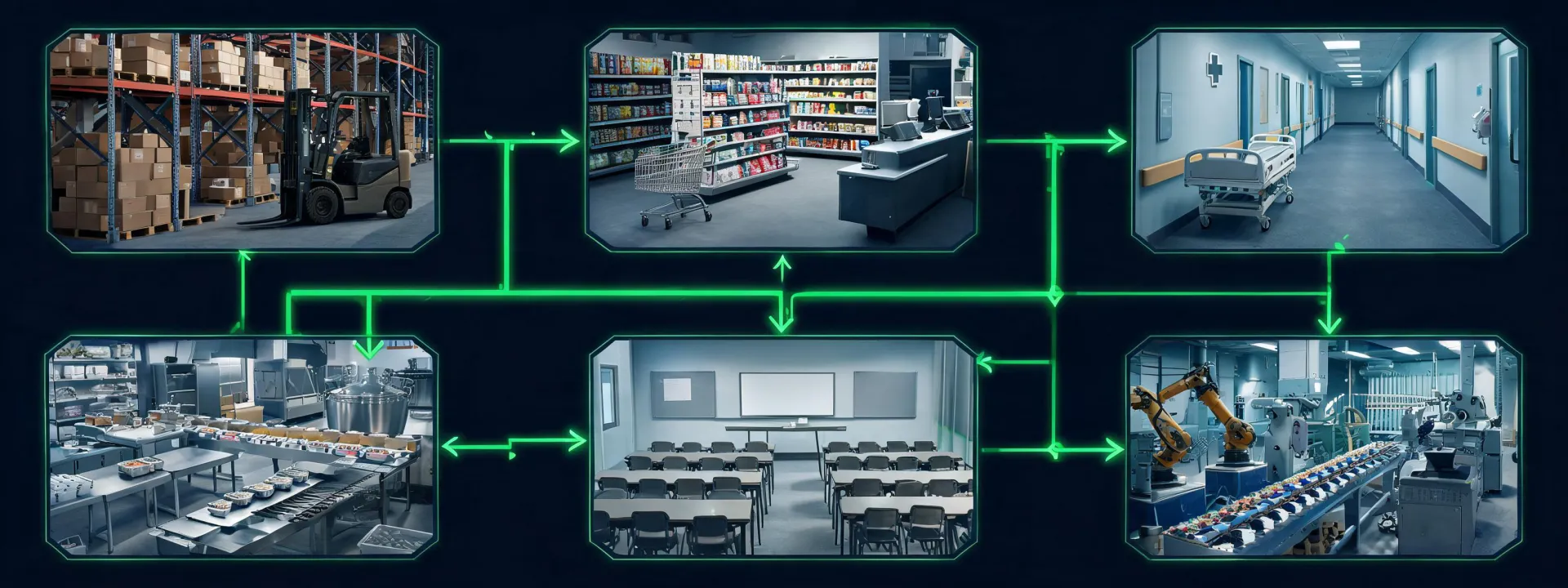
Warehouse & logisticsLong aisles, dock soil, and moving traffic
Map pallet debris, tire marks, dust migration, dock transitions, aisle ends, rack clearances, cross traffic, and the distance between refill, dump, charging, and storage points. A sweeper may remove loose material before a scrubber addresses bonded soil.
- Trial focus
- Turning clearance, pickup before scrubbing, recovery, drying, and safe interaction with vehicles.
- Limitation
- A large ride-on machine may cover open floor efficiently but cannot prove suitability for narrow or congested zones without a route test.
Retail & public venuesPresentation standards within short access windows
Entrances, food areas, checkout zones, fixtures, pedestrian traffic, and changing seasonal soil create a fragmented route. Noise, visibility, edge access, cord or hose control, and dry-to-traffic condition can matter as much as nominal productivity.
- Trial focus
- Low-speed maneuvering, edge work, floor appearance, noise, recovery, and reopening time.
- Limitation
- A high theoretical coverage rate does not include moving displays, isolated spots, setup, refill, or the work needed outside machine reach.
Healthcare & educationOccupied corridors, rooms, and documented routines
Routes may cross patients, students, staff, doorways, elevators, thresholds, and sensitive spaces. The method needs clear chemical compatibility, slip-risk control, clean and dirty handling, noise expectations, operator training, and escalation procedures.
- Trial focus
- Visibility, maneuvering, controlled solution, pickup, drying, storage, and handoff documentation.
- Limitation
- Machine cleaning does not replace facility-specific infection-control or safety procedures; responsible teams must validate the complete method.
Food & beverage productionResidues, drainage, zoning, and sanitation boundaries
Wet process areas can combine organic soil, oils, drainage, slopes, fixed equipment, traffic, and strict separation of tools or zones. Equipment material compatibility and cleaning of the machine itself require explicit review.
- Trial focus
- Soil removal, recovery on slopes and joints, access around equipment, drainage interaction, and post-use cleaning.
- Limitation
- A floor scrubber is not an automatic substitute for a validated sanitation procedure, and the site must confirm chemical, material, and zoning requirements.
ManufacturingProcess debris, films, work cells, and shift change
Metal chips, packaging fragments, dust, oils, coolant tracking, cables, guards, and variable aisle access can require different collection and scrubbing steps. Hazardous or combustible material must be identified before any vacuum or sweeper is considered.
- Trial focus
- Material identification, filtration or collection needs, obstacle clearance, floor finish, and disposal method.
- Limitation
- Standard equipment must not be assumed suitable for hazardous locations or combustible dust; obtain application-specific documentation.
Municipal & large campusesMultiple surfaces, buildings, operators, and service points
A campus fleet may serve parking structures, transit spaces, workshops, public buildings, and event areas. Route assignment, transport between sites, charging, storage, consumables, operator authorization, and service records can determine utilization.
- Trial focus
- Route segmentation, machine transport, training consistency, charging access, and preventive maintenance ownership.
- Limitation
- Standardizing one machine can simplify support but may leave specialized surfaces or restricted spaces poorly served.