Define the route envelope
Measure area, travel distance, aisle width, turning points, slopes, thresholds, lifts, doors, obstacles, storage, refill, disposal, charging, and transport between work zones.

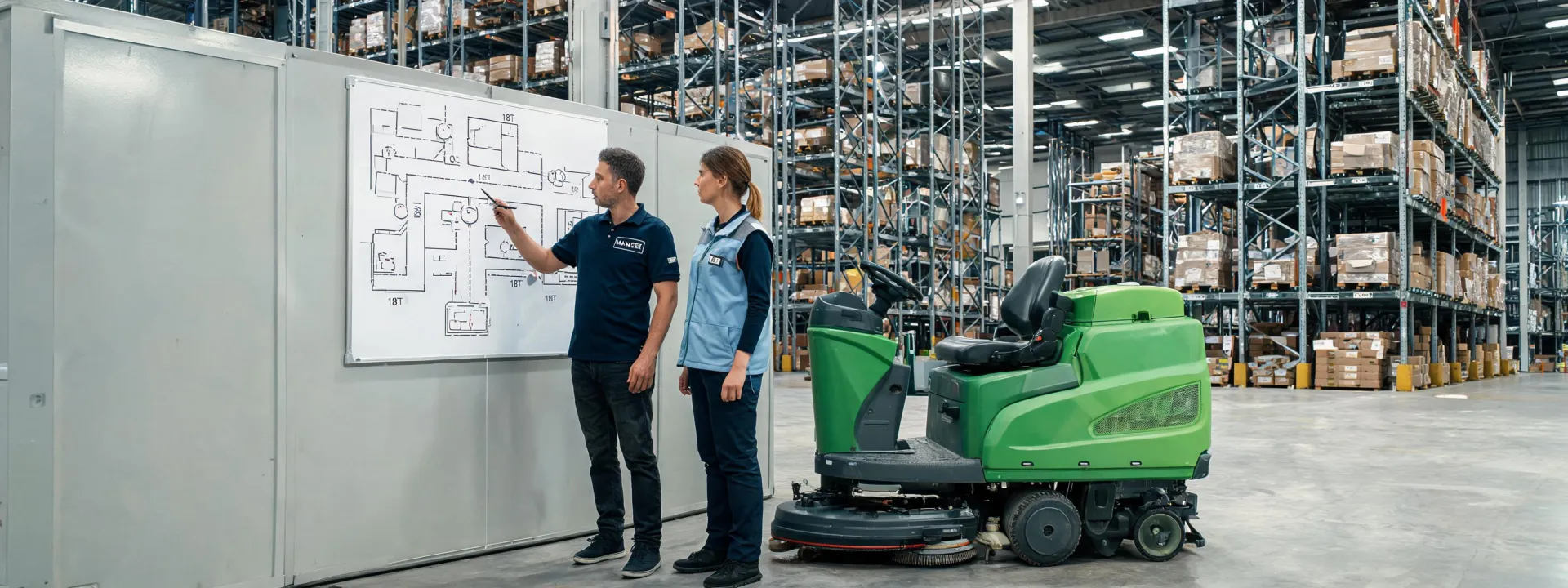
An application is more than an industry name. It is a specific surface, soil, route, traffic pattern, operating window, utility plan, operator workflow, service requirement, and observable acceptance result.
The most useful machine recommendation states what is known, what remains uncertain, and how the facility will verify fit. Tennant application planning organizes those facts before a site trial, so product screening and operating evidence stay connected.
A specification can indicate scrub width, tank capacity, power source, filtration, or machine dimensions. It cannot, by itself, prove how a unit will turn at the end of a crowded aisle, recover solution from a worn or uneven floor, interact with real traffic, or fit the team’s inspection and service routine.
Measure area, travel distance, aisle width, turning points, slopes, thresholds, lifts, doors, obstacles, storage, refill, disposal, charging, and transport between work zones.
Identify loose debris, films, oils, tracked material, dust, periodic buildup, edge work, and any hazardous or regulated material that changes collection or disposal requirements.
State the expected finish, pickup, recovered material condition, dryness, safe return to traffic, permitted rework, operator steps, and records required for approval.
These bars represent briefing stages, not performance claims. Move each stage forward only when the responsible team has supplied or reviewed the underlying information.
Incomplete facts do not always block an early conversation, but they should remain visible as trial questions. This prevents an assumption from being repeated later as if it were a verified requirement.
Results remain site-specific. Tool wear, floor condition, operator technique, chemistry, temperature, soil variation, and traffic can change the outcome. Any hazardous-location, combustible-dust, sanitation, or product-compliance requirement needs model- and application-specific documentation from responsible parties.
Describe the conditions that make the current method slow, inconsistent, difficult to support, or hard to verify.